 Download guide
Ownership
Know what each investor owns.
Investors hold security entitlements to company shares in custody. Street records each investor’s position; the issuer’s ledger names the custodian or nominee.
Explore the ownership model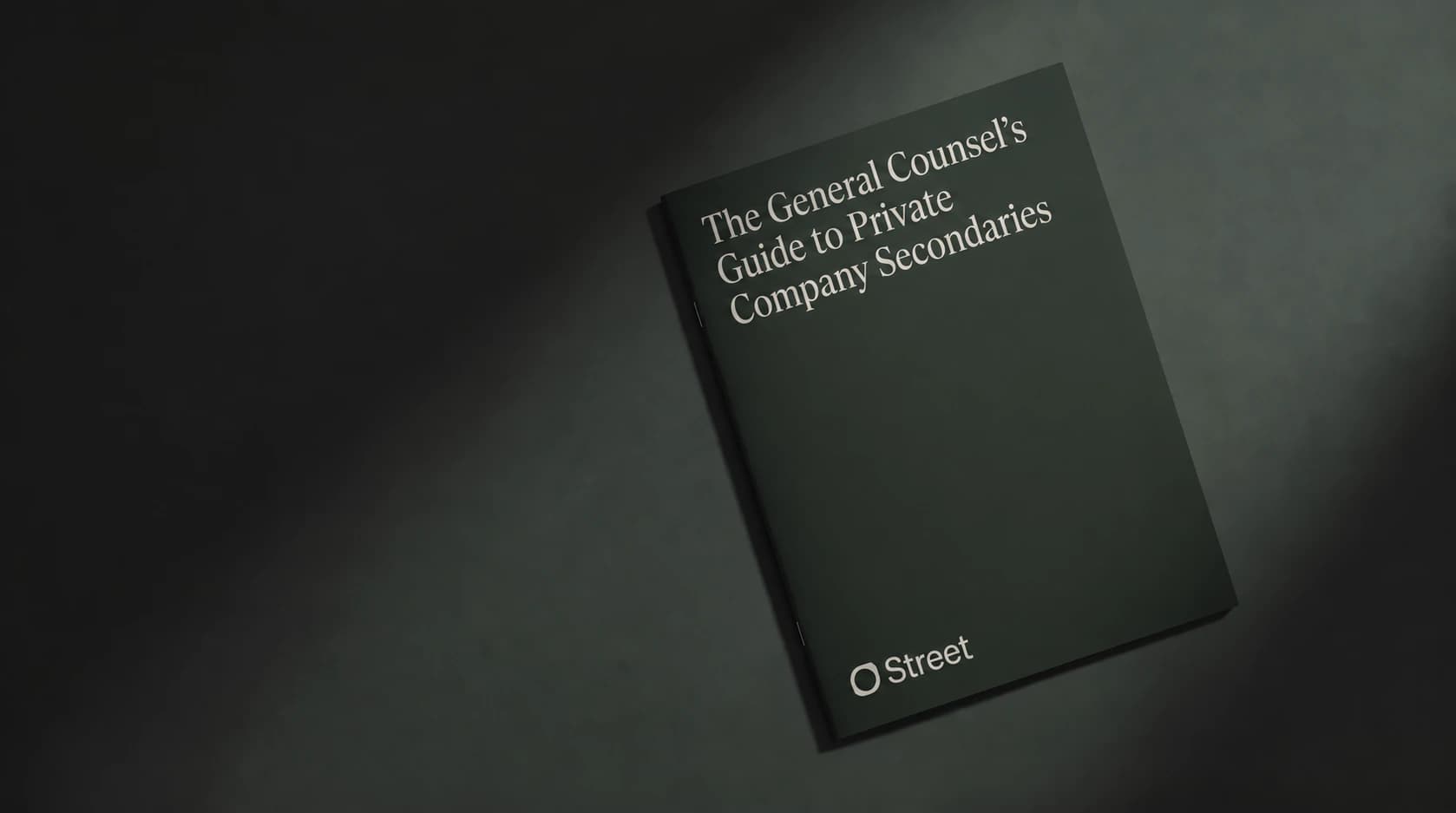
Guide · For general counsel
Ownership, transfer authority, and the legal architecture behind Street.
Follow the underlying shares, the registered holder, and the investor’s security entitlement.
Connect company approvals and transfer rights to the proposed transaction.
Identify the agreements and operating responsibilities to review.
Inside Street’s architecture
Ownership
Investors hold security entitlements to company shares in custody. Street records each investor’s position; the issuer’s ledger names the custodian or nominee.
Explore the ownership model Common shares
100 share units · Seller to buyer
Custodian / nominee
Before trade: the seller has 600 shares’ worth of entitlements and the buyer has 400. The custodian or nominee remains registered for 1,000 underlying shares on the issuer stock ledger.
Transfers
Entitlements move between investors. The nominee can remain registered for the same underlying shares.
Follow the transactionCompany authority
Review the company approvals, transfer rights, and account conditions that govern a proposed transaction.
Understand transfer authority409A valuation
A secondary price is one piece of evidence. Your appraiser weighs its relevance alongside the share rights and transaction terms.
Read the 409A analysisAn issuer-approved scope for participation, with the relevant company and third-party transfer rights addressed before trading.
Board approvals, transfer consents, ROFR and co-sale provisions, and any waivers.
Existing company shares in custody, with a nominee on the issuer register and participant entitlements recorded by the intermediary.
Custody agreement, nominee recognition, entitlement terms, and the mapping between the two records.
Transfers confined to eligible accounts within the entitlement system, subject to the conditions applicable to the account and transaction.
Account terms, investor checks, transfer restrictions, and procedures for a change in eligibility.
A defined information package and an identified transaction pathway. Quotation and publication requirements need their own assessment.
Resale disclosures, access policy, update responsibilities, and the review of any quotation requirements.
Coordinated payment and entitlement updates, with procedures for discrepancies, distributions, voting instructions, and delivery out.
Funds-flow diagram, settlement procedures, reconciliation records, and corporate-action terms.
Inside the guide
Read the legal analysis with its authorities, follow the ownership and transaction diagrams, or download the complete guide.
Separate the asset, the change in ownership and the operating relationship before evaluating the mechanics.
The corporate share, the registered position and the participant’s entitlement each have a defined place.
An authorization is effective only within the rights the company and other parties actually hold.
A limited secondary need not reset the 409A valuation. Its influence depends on the evidence, the security being valued and the conditions at the relevant date.
Select the route for the actual issuer, seller, purchaser and transaction; an exemption is not a transferable platform permission.
Identify the entity performing each regulated function and the information consequences of the market design.
A securities trade, cash payment and entitlement update are related events with separate evidence.
The share terms supply the underlying rights; the account relationship determines how they are exercised through custody.
Review the architecture under stress and distinguish evidence of a legal right from evidence that an operating condition is met.
Questions that come up early
In the nominee custody structure explained in this guide, the custodian or nominee is the registered holder on the issuer’s stock ledger. Each investor holds a security entitlement recorded in the intermediary’s securities accounts. Those records answer different legal questions. A shared database does not make an entitlement holder an individually registered shareholder.
In the model described here, it is part of how entitlements are recorded and transferred. The rights associated with the underlying shares still depend on the share terms, custody arrangement, and applicable law. A token label by itself does not establish voting rights, remove transfer restrictions, or determine the legal treatment of a transaction.
Street’s entitlement architecture confines transfers to eligible accounts in the intermediary’s system. An internal entitlement transfer and delivery of underlying shares out of custody are separate processes. Delivery out requires the relevant account instructions, applicable transfer conditions and issuer registration steps where the exit route requires a registered transfer. Control of a wallet alone does not remove those conditions.
A primary issuance and a shareholder resale are different transactions. A Rule 506(c) financing may be considered separately where it serves a real capital-raising purpose; it is not a universal prerequisite for a secondary program or a substitute for satisfying the conditions of a later resale.
Information access depends on the transaction and market structure. A resale information package, a restricted trading environment, and rules governing publication of quotations are separate questions. A company should establish what must be shared, with whom, and whether any information must be publicly available before agreeing to participate.
The SEC’s notice records the effectiveness of Street Labs, Inc.’s transfer-agent registration on August 20, 2026, under file number 084-07093. Transfer-agent registration concerns that function. It does not establish broker-dealer, ATS or customer-custody permissions, or constitute regulatory approval of a transaction. The guide separates those operating roles and the evidence relevant to each.
For your company’s legal team
Work through the ownership model, operating parties, transaction pathway, and agreements for your company’s program.
Discuss an issuer review